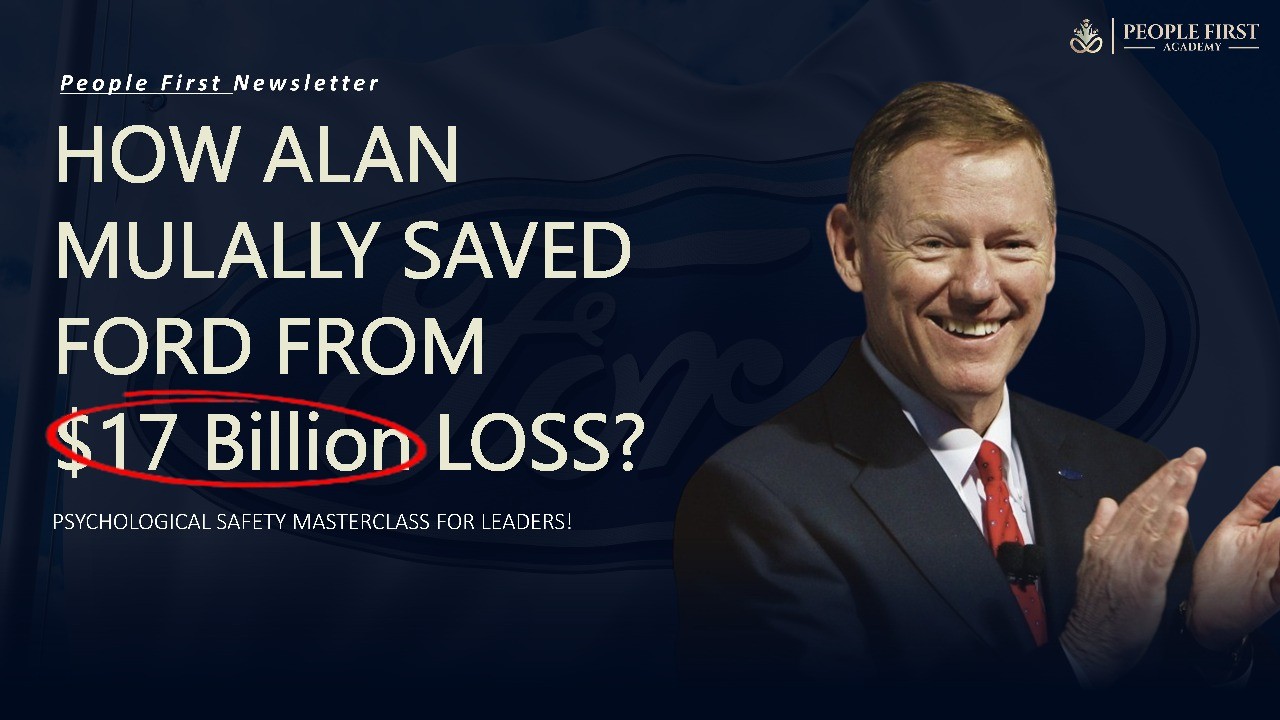
How a Leader Saved Ford from a $17 Billion Loss?

“People don’t leave jobs. They leave toxic cultures.”
We’ve all heard this. But have you ever asked yourself:
What exactly makes a culture toxic?
Let’s be honest—at some point in our careers, we’ve all experienced this:
- You hesitate to speak up in meetings.
- You feel forced to follow orders without being heard.
- You know your ideas or suggestions won’t matter anyway.
- You fear judgment if you raise problems or admit mistakes.
This is what a lack of psychological safety feels like. And when that becomes the norm across an organization, it creates a toxic work culture—a culture of fear, silence, and pretense.
Understanding Psychological Safety
Psychological safety is a feeling a belief that you are safe while working with your leader and your team.
It’s not about being soft. It’s about being human.
It’s the freedom to speak up, take risks, ask questions, admit mistakes, and share ideas—without fear of punishment or embarrassment.
When people feel psychologically safe:
They build trust with the leader and one another.
They admit mistakes quickly, leading to faster problem-solving.
They share ideas freely, driving innovation and creativity.
They care more about the team, not just the task.
In short, psychological safety creates a winning culture—not just emotionally, but also financially.
When Alan Mulally became CEO of Ford Motor Company in 2006, the company was on the verge of collapse with a staggering $17 billion loss.
The culture was broken. Executives were hiding problems. No one admitted mistakes. Everyone was protecting themselves.
So what did Mulally do?
He didn’t bring in new products first. He didn’t fire people first. He didn’t restructure departments first.
He changed the culture first.
Here’s how:
In his very first meetings, Mulally asked executives to color-code their progress on key goals:
- Green = On track
- Yellow = Caution
- Red = Off track
But every single leader showed green—even though Ford was bleeding money.
Instead of reacting angrily, Mulally calmly said:
“We can’t manage a secret. If everything is green, then we’re not seeing reality. And if we don’t face reality, we can’t fix it.”
He made it clear: if you speak up, share problems, and admit mistakes—you won’t be punished.
But still, no one told the truth.
- 1st meeting: No red slides.
- 2nd meeting: Same result.
- 3rd meeting: Still green.
- 4th meeting: No one opened up.
Each week, Alan encouraged the team to speak up and assured them it was safe to do so.
It took seven continuous weeks of consistent messaging and calm leadership.
Then in the 8th week, a leader named Mark Fields took the risk.
In the 9th Business Review Meeting, he showed a red slide and openly shared a major issue at a production plant. He also admitted the mistakes made by his team.
Everyone in the room froze.
They thought sharing problems meant losing your job.
But instead of punishing Mark, Mulally smiled and clapped:
“Hey Mark, thank you for sharing that. That’s great visibility. Team—how can we help Mark solve the problem?”
That moment changed everything. Mark was not punished—he was appreciated. Promoted, even.
The message was loud and clear:
If you admit mistakes, you won’t be punished—you’ll be respected, encouraged, and supported.
From the next meeting onward, the colors began to change.
Some greens. Some yellows. Finally—some reds.
The culture of fear had turned into a culture of truth.
People started talking. Admitting. Helping. Innovating.
And over time, the company that was about to lose $17 billion turned around and earned a $6.6 billion profit.
All because one leader created psychological safety.
What Happens When Psychological Safety Is Missing?
A culture without psychological safety becomes a breeding ground for fear, silence, and collapse.
We’ve seen this again and again:
Enron – Culture of fear and manipulation collapse
Wells Fargo – Employees afraid to question fake accounts $3 billion fine
Theranos – No room for doubt or transparency criminal charges
Uber (pre-2017) – Internal chaos, lawsuits, and mass resignations due to toxic leadership
When employees hide problems, fear leaders, or stay silent, the business suffers—sometimes beyond repair.
As a Leader, Ask Yourself:
- Do your team members feel safe admitting mistakes?
- Are your meetings open or fear-driven?
- Do people speak up… or shut down?
If the answer worries you, the solution isn’t complicated. It begins with simple behaviors:
Say “Thank you” when someone points out a problem.
Ask questions instead of giving orders.
Share your own mistakes first.
Celebrate honesty—not just results.
Culture is Created by Consistency
Psychological safety isn’t built in a single meeting or workshop. It’s built through consistent behavior by the leader—every day, in every interaction.
The real question is not “How smart is your team?” It’s “How safe do they feel to show their intelligence?”
Final Thought:
“In the absence of psychological safety, even the best people fail. In the presence of it, even average people do great things.”
Alan Mulally didn’t just save Ford. He proved that leadership isn’t about being the smartest in the room—it’s about making others feel safe enough to be smart.
So, what kind of culture are you creating?
At People First Academy, we imagine a world where the vast majority of people feel heard, valued, and safe wherever they work. A world led by leaders who prioritize people over profit, responsibility over blame, and purpose over pressure.
We help build this world by training managers and leaders in human skills — helping them become true leaders without depending on titles or positions.
If you’re looking to train your managers and leaders to become true, people-first leaders, you can drop us an email at contact@peoplefirstacademy.in or book a strategy call by clicking the ‘Book an Appointment’ button.
I’d love to connect with you and collaborate to make your workplace better!
Question for Leaders -
Mulally's story is a powerful example of a leader prioritizing culture over quick fixes. As a leader, what's the one small, consistent behavior you can start doing today to build more psychological safety on your team?
Let's have a discussion in the comments below!
Haven’t subscribed to the People First Leadership newsletter yet? You’re really missing out on valuable insights that can help you grow into a true people-first leader. Subscribe today and don’t miss the next issue!
If you also believe that listening is a leader’s superpower, go ahead and repost or share this with your managers, leaders, or team members—and help them understand the true value of listening in leadership.
See you in the next newsletter with another leadership insight and a powerful story. Until then —
Take care of yourself, and take care of those around you.
Thank you!


Comments
Be the first to share a thought on this article.
Leave a comment